What a $500M Ethernet Switch Company Tells Builders About the Next Two Years
By Mohammad Khan
Most founders are focusing on one layer: application. Every major AI infrastructure cycle follows the same arc: a constraint gets identified, capital floods in to solve it, and once the bottleneck clears, an entirely new layer of applications becomes viable that wasn't before. We've watched this play out twice already. We're in the middle of the third, and the capital being deployed right now is the clearest signal of where the next product window opens.
The Pattern: Bottlenecks Define Eras
The AI build cycle isn't linear. It's sequential. Each era is defined not by what becomes possible at the application layer, but by what gets solved at the infrastructure layer beneath it. Applications follow infrastructure, they don't lead it. Understanding which layer is currently constrained tells you where the next generation of products will emerge, and roughly when.
Wave 1: What Unlocked When Compute Scaled
The first wave was visible to everyone. As compute became more accessible, an entire product category materialized almost overnight: real-time inference became cheap enough to ship at consumer scale, multimodal experiences became table stakes, SaaS layers got rebuilt around automation, and consumer AI products found mass audiences in months, not years. The application layer didn't lead this wave, it followed it.
Wave 2: The Bottlenecks That Defined 2023 to 2025
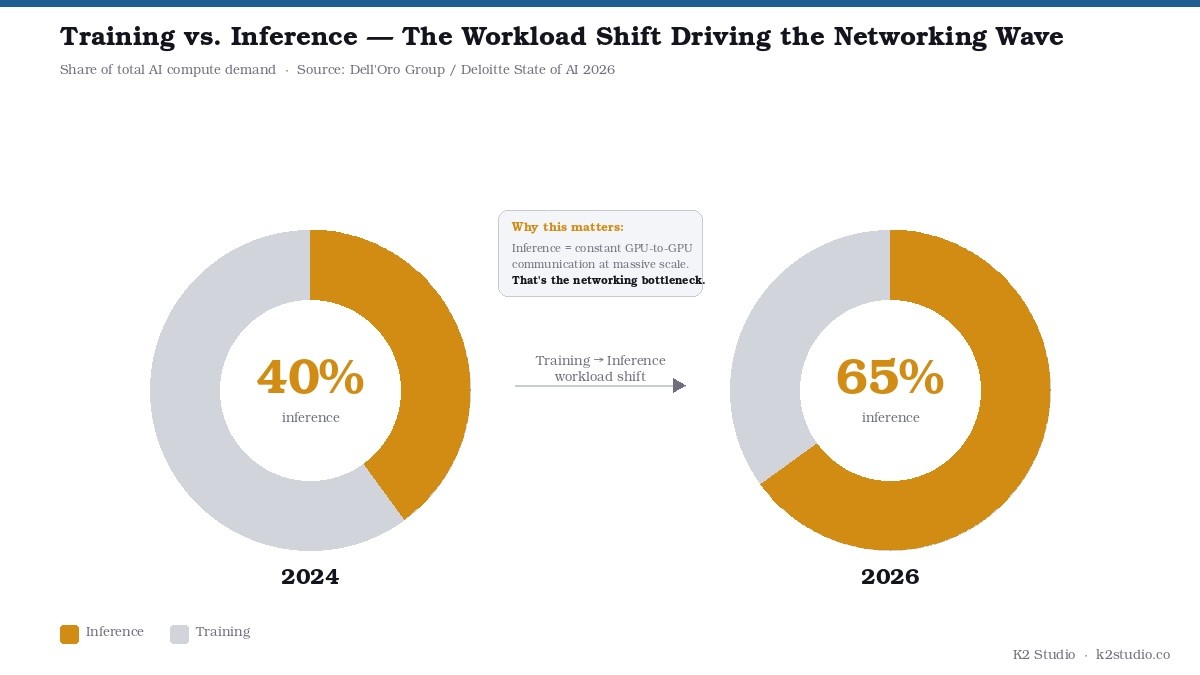
Before applications could scale, compute had to. GPU scarcity defined the first two years of the AI era. NVIDIA became the most discussed company in tech. Then the constraint shifted inward, from chips to memory. HBM demand grew 130% year over year in 2025, and DRAM prices rose roughly 50% in the same period. Alongside this came the shift from training to inference, which now accounts for 60 to 70% of total AI compute demand, up from roughly 40% in 2024.
Wave 3: Networking, the Active Bottleneck
Inference at scale looks nothing like training. It means thousands of GPUs coordinating constantly, in real time, across massive distributed clusters. A single NVIDIA DGX H100 server generates up to 3.2 terabits per second of aggregate bandwidth, and a 1,000-GPU cluster requires sustaining over 400 terabits per second of all-to-all traffic with near-zero packet loss. Traditional data center switches weren't built for these patterns.
Ethernet has already overtaken InfiniBand as the dominant protocol in AI backend networks, a near-complete reversal from two years ago. Nexthop AI just raised $500M at a $4.2B valuation to build Ethernet switches designed natively for AI workloads. a16z, Altimeter, Lightspeed, and Kleiner Perkins are in the round. When that constellation of investors concentrates on a single infrastructure bet, the thesis has been stress-tested.
What the Numbers Say
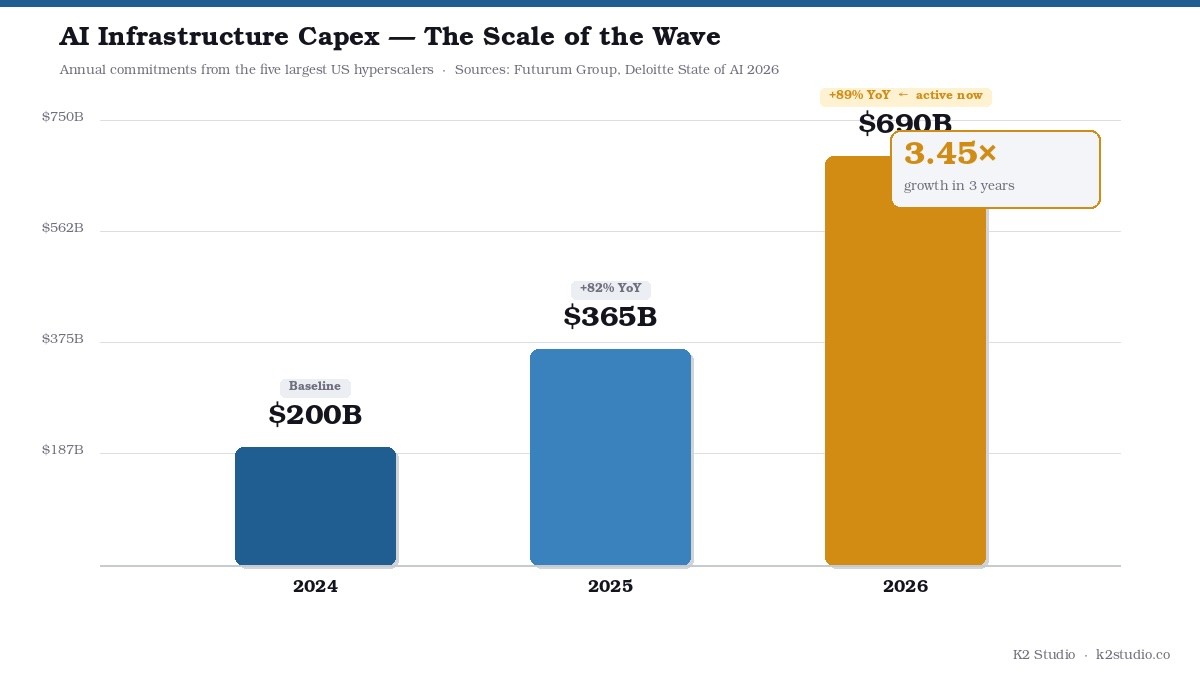
$690 billion in AI infrastructure is being committed in 2026 alone, nearly double the ~$365 billion deployed in 2025. McKinsey estimates AI-capable data centers will require $5.2 trillion in capital expenditures by 2030. 1.6 Tbps network switches are expected to ship in volume in 2026. This is not maintenance spend. It is the foundation for a generation of applications that don't yet exist.
What This Means for Builders
The pattern is consistent: when an infrastructure bottleneck clears, a new class of applications becomes viable that couldn't exist before. Faster compute made real-time inference possible. Solving the networking layer will make larger, more coordinated, more distributed multi-agent systems viable at a cost and reliability threshold that's actually deployable in production.
The infrastructure capex being placed right now is a map of what will be cheap and fast in 18 months, and therefore what product bets start to make sense. Most founders are looking at the application layer. The more useful question is what the infrastructure layer is about to make possible. This is the lens K2 uses to think about where the next generation of products gets built. The window is opening. The question is who's positioned for it.