Why Most Enterprise AI Fails: It's Not the Model, It's the Deployment
By K2 Studio
"Why can't I just do this on Claude myself and spin up something similar? How would this be any different?"
You're going to hear that a lot. It's an extremely valid question, so make sure you have a strong answer. The answer isn't in the technology. It's in the deployment model.
OpenAI grew their Forward Deployed Engineering team from 2 to 52 engineers in a single year. Anthropic is scaling its equivalent team fivefold. Salesforce, xAI, Ramp, Databricks, and Adobe have all quietly built the same capability. Job listings for the role surged 800% in 2025 alone. These are not coincidences. They are signals.
The most sophisticated builders in the world have converged on the same answer to the same problem, and the answer isn't a better model, a cleaner interface, or a more elegant architecture. It's a fundamentally different approach to how AI applications get built and deployed inside real organisations. That approach is called Forward Deployment.
Most people are having the wrong conversation
The debate is usually about which application to ship, which workflow to automate, which use case to prioritise. And while that conversation dominates, the actual problem, the one quietly killing most enterprise AI initiatives, goes completely unaddressed. It's not the application. It's what happens after it's built.
The numbers
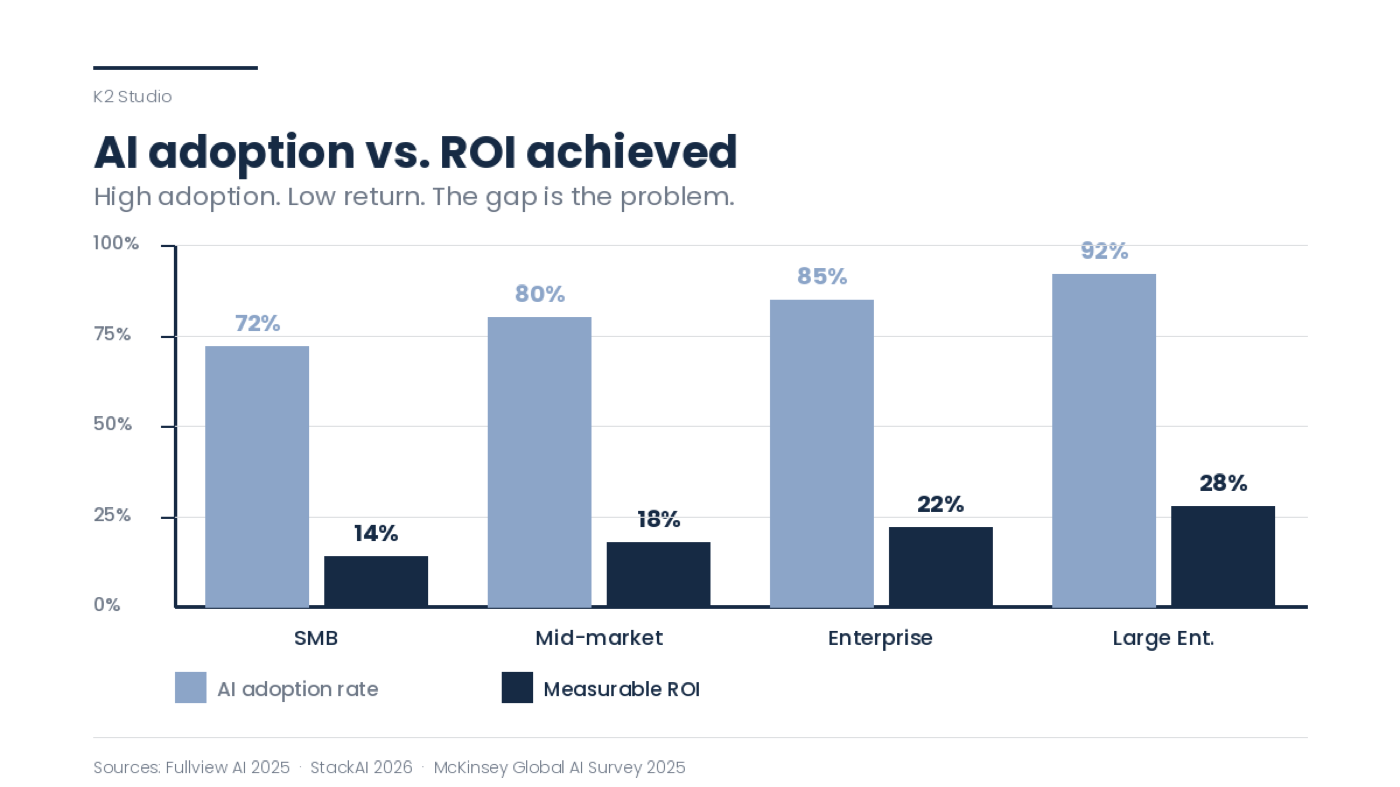
The average enterprise runs 897 applications. 71% of them are unintegrated or disconnected, a number that hasn't moved in three consecutive years. 70 to 85% of AI initiatives fail to meet their expected outcomes. Only 26% of organisations ever successfully move a pilot into production.
These aren't failures of imagination or engineering. They're failures of deployment. The application worked fine in the sandbox. It fell apart when it met reality: fragmented data, legacy infrastructure, unclear ownership, and workflows nobody documented because everyone just knows how they work.
The signals
Building the application is step one. Getting it to production is step two. Getting it embedded into daily operations is step three. Getting it to the point where removing it costs more than keeping it, that's the actual goal. The companies gaining serious enterprise traction in 2026 have figured out that the deployment model is the product strategy.
OpenAI's FDE team grew from 2 to 52 engineers in 2025 alone, and they've since launched the Frontier Alliance, pairing forward deployed engineers with BCG, McKinsey, Accenture, and Capgemini. Anthropic is scaling its Applied AI team fivefold. Salesforce adopted the same model for Agentforce. Infosys is scaling its FDE team across 4,600 active AI projects. Accenture has trained 30,000 consultants to embed with clients. And xAI is sending engineers directly into client offices, with Shift4 Payments signing a multi-million-dollar contract after an on-site engagement.
What actually works
Go in. Understand the terrain before you build on it. Sit with the team that will actually use the application. Learn what the SOPs say, and what they don't. Find the workflows nobody mapped because they evolved organically over a decade. Then build, not a demo, not a proof of concept, something that runs in production against real edge cases, real data, and real constraints.
OpenAI's FDE team working with Morgan Stanley achieved 98% adoption rates and 20 to 50% efficiency improvements, not by building a better model, but by embedding with the team and building something precisely fitted to how they actually work. You cannot build for an environment you've never stood inside.
Why this compounds
Every engagement run this way generates real field intelligence: the edge cases that don't show up in discovery calls, the integration patterns that only become visible once you're inside the system, the organisational dynamics that determine adoption. That intelligence feeds back into the product. The application gets sharper. The next deployment gets faster. The moat deepens, not because you locked someone into a contract, but because replacing what you built costs more than keeping it.
Forward deployment isn't a service offering. It's a philosophy about where the real work of building happens. In a market flooded with capable AI products, everyone can build something. Most will fail, not because the technology was wrong, but because the approach to getting it into the world was. The companies that win this decade won't be remembered for what they built in the lab. They'll be remembered for how they deployed it. How you deploy is the strategy.